


 +86 18130251359
 teflowpumps@tlpumps.com

Front-end wet cleaning of semiconductor wafers is a core process for controlling chip manufacturing yield. From RCA standard SC1 and SC2 cleaning, dilute hydrofluoric acid pickling, photoresist stripping, to deionized water rinsing and surface microparticle removal, the entire process imposes stringent requirements on chemical liquid delivery. Unlike common chemical corrosion conditions, media for wafer cleaning include high-purity electronic chemicals such as ammonia water, hydrogen peroxide, hydrofluoric acid and dilute hydrochloric acid, as well as photoresist strippers. Trace metal ions and particle precipitation will directly cause wafer defects and reduce chip yield. Meanwhile, the media are highly corrosive, and some cleaning tanks operate under heated circulation for a long time, leaving very little margin for pump selection.
Many semiconductor wet benches and centralized chemical supply systems frequently encounter issues including particle generation from mechanical seal wear, ion leaching from pump materials, chemical leakage and catalytic decomposition of oxidants. Such failures are not simply caused by corrosion; the root cause lies in the mismatch of pump structure and wetted materials with the special working conditions of high-purity semiconductor cleaning.
Ⅰ.Working Conditions and Media Characteristics of Each Wafer Cleaning Process
1. SC1 Cleaning (Ammonia + Hydrogen Peroxide + Ultrapure Water): Alkaline high-temperature oxidizing chemical, used to remove organic contaminants. Hydrogen peroxide is prone to catalytic decomposition by metals, requiring metal-free flow paths and low particle generation.
2. SC2 Cleaning (Dilute Hydrochloric Acid+Hydrogen Peroxide+Ultrapure Water): Acidic oxidizing system to remove metal impurities on wafer surfaces, with ppb-level control requirements for metal leaching from pump bodies.
3. Dilute Hydrofluoric Acid Cleaning (DHF): Highly corrosive medium that attacks most metallic materials, used for oxide layer stripping. Wetted components must not come into contact with ordinary stainless steel.
4. Photoresist Stripping: Alkaline strippers. Some formulations contain surfactants; material leaching of organic substances that contaminate the chemical liquid must be avoided.
5. Deionized Water Rinsing: 18.2 MΩ·cm ultrapure water. Piping and pump bodies require extremely low particle and ion leaching to flush residual chemicals off wafers.
Core selection criteria: High purity with no metal contamination, low ion leaching, strong corrosion resistance, zero leakage and low particle generation during operation. Mechanical dynamic seals should be eliminated preferentially to remove particle and leakage risks at the source.
Ⅱ. Main Recommended Pump Types for Wafer Cleaning and Applicable Scenarios
Fluoroplastic Magnetic Drive Pump (Primary Recommended Option)
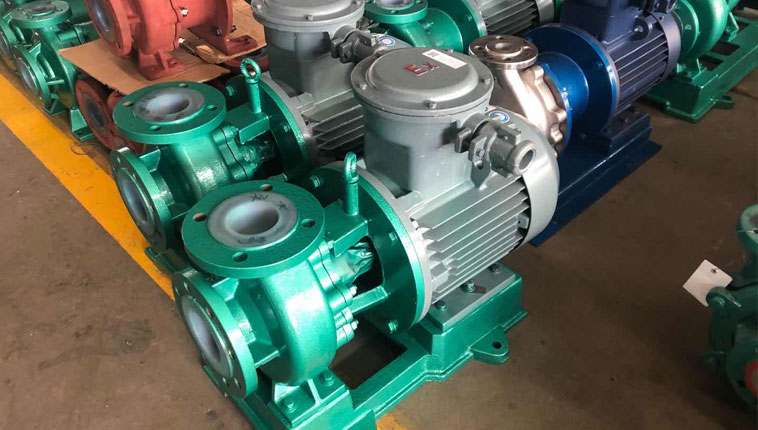
Adopting magnetic coupling transmission without mechanical dynamic seals, it converts dynamic seals into static seals to achieve zero medium leakage. It is the most widely used pump for wet cleaning tank circulation and chemical delivery in semiconductor processes.
Wetted components: High-purity integrally molded PFA is preferred for high-temperature circulation conditions; FEP can be used for medium and low-temperature applications below 80°C. Silicon carbide is adopted for pump shafts and bearings, ensuring no metal contact with chemical liquids throughout.
Applicable conditions: Delivery of SC1/SC2 cleaning solution, dilute hydrofluoric acid, dilute hydrochloric acid, photoresist stripper and deionized rinse water, covering full scenarios including cleaning tank circulation and high-purity chemical replenishment.
Advantages: Extremely low metal ion leaching, smooth surface resistant to particle adhesion, excellent corrosion resistance, no catalytic effect on hydrogen peroxide decomposition, stable structure and good compatibility with cleanrooms.
Notes: Dry-run control is required to prevent high-temperature damage to the containment shell, with liquid level protection equipped.
Not recommended: Traditional centrifugal pumps with metal spring mechanical seals. Friction between rotating and stationary rings of mechanical seals easily generates solid particles. Seal springs and metal fasteners may corrode and leach metal ions, directly contaminating cleaning chemicals, which is a prohibited selection for semiconductor front-end cleaning.
Ⅲ. Key Points for Pump Selection in Wafer Cleaning
1. Strict control of ion and particle leaching: All parts in contact with chemicals must adopt semiconductor-grade high-purity raw materials to avoid impurity precipitation from additives in ordinary fluoroplastics. Pump inner walls should preferably be integrally molded to reduce seam dead zones and chemical retention.
2. Avoid catalytic decomposition of hydrogen peroxide: No bare metal shall be present in chemical contact areas. Metals will accelerate hydrogen peroxide decomposition, causing foaming in tanks, chemical failure and even potential safety hazards.
3. Prioritize zero leakage: Most semiconductor chemicals are highly corrosive hazardous substances. Leakage in cleanrooms will not only contaminate wafers but also damage the clean environment. Shaft-seal-free fluoroplastic magnetic drive pumps are preferred.
4. Anti-cavitation and stable circulation: Trace bubbles are easily introduced during cleaning tank circulation. Sufficient net positive suction head (NPSH) shall be reserved in pump selection, with pipeline filters fitted to reduce particle backflow to wafers.
5. Chemical temperature serves as the dividing line between PFA and FEP selection: PFA is preferred for high-temperature SC1/SC2 cleaning loops above 80°C; FEP can be used for chemical delivery at room or medium-low temperature below 80°C.
6. Perform chemical compatibility verification for materials in advance: Stripper formulations vary greatly among manufacturers. Immersion and leaching tests are recommended before formal installation.
For front-end wet cleaning of semiconductor wafers, pumps are not merely used to transport chemicals. Their core value is to safeguard chemical purity and guarantee wafer yield. Fluoroplastic magnetic drive pumps with high-purity PFA/FEP wetted parts are uniformly recommended for delivery of a full range of front-end high-purity chemicals including SC1/SC2, hydrofluoric acid, pickling solutions, photoresist strippers and ultrapure rinse water.
Tiny defects in pump materials and seal structures will be amplified in semiconductor micron-scale processes. Only by fully matching high-purity corrosive conditions in terms of pump type, wetted materials and operation protection can ion and particle contamination be stably controlled and production line downtime risks reduced.



 +86+0563-5093318
