


 +86 18130251359
 teflowpumps@tlpumps.com


Papermaking is a typical process-oriented chemical industry. From pulping, bleaching and alkali recovery to pulp transportation, white water circulation, precise chemical dosing and terminal wastewater treatment, the entire process involves complex and diverse media. Caustic soda, sodium hypochlorite, hydrogen peroxide, bleaching liquor, black liquor, white liquor, fiber-containing slurry and high-salinity wastewater appear alternately, with working conditions featuring strong alkalinity, strong oxidizing property, high solid-content fibers and easy scaling.
As core fluid transportation equipment, improperly selected pumps are highly prone to failures such as oxidant-induced corrosion perforation, fiber entanglement and clogging, alkali corrosion leakage of black liquor, and excessive impeller wear. These failures not only disrupt production rhythm, but also pose safety and environmental risks from leaked strong alkali and bleaching agents.
Core criteria for pump selection in the paper industry: resistance to acid, alkali and strong oxidants, anti-fiber clogging performance, wear and erosion resistance, and leak-free operation, to adapt to the long-period continuous operation characteristics of pulp and paper production.
I. Working Conditions and Medium Pain Points of Each Papermaking Process
1. Pulping and Pulp Transportation Process
The medium consists of fiber-containing pulp and wood chip cooking liquor, mixed with fine fibers, fillers and lignin residues, featuring high solid content and long fibers. The core challenge is that fibers easily entangle the impeller and block flow passages, while the slurry erodes and wears the pump chamber. Ordinary centrifugal pumps frequently suffer from stalling and rapid efficiency degradation under such conditions.
2. Bleaching Process
The bleaching section uses a large volume of strong oxidizing bleaching agents including sodium hypochlorite, hydrogen peroxide, caustic soda and chlorine dioxide, with wide pH fluctuations and high chloride ion content. The highly oxidizing and corrosive medium causes rapid oxidation and rusting of ordinary stainless steel and cast iron pumps. Precipitated metal ions also catalyze the decomposition of hydrogen peroxide and sodium hypochlorite, leading to reduced bleaching efficiency and increased reagent consumption.
3. Alkali Recovery Process
This process covers three core media: black liquor, green liquor and white liquor, all of which are high-concentration alkaline systems with temperatures reaching 80–100℃, accompanied by solid particles such as alkali scale and lime residue. Under high-temperature concentrated alkali environments, ordinary metals are susceptible to alkali embrittlement stress corrosion. Combined with continuous erosion from solid particles, equipment fails rapidly under the dual effects of corrosion and wear.
4. White Water Circulation and Chemical Dosing Process
White water contains fine fibers, fillers and residual chemicals, requiring stable pump operation without introducing foreign impurities. For dosing of various papermaking additives and acid-base chemicals, precise metering and zero leakage are core requirements, to avoid reagent ratio imbalance that affects finished paper quality.
5. Papermaking Wastewater Treatment Process
Terminal wastewater has complex components, mixed with acid, alkali, lignin, fiber residues and high salinity, with large water quality fluctuations and entrained sludge suspended solids. Pumps must deliver both acid-alkali corrosion resistance and particle wear resistance, and leakage is strictly prohibited to prevent environmental incidents.
II. Main Recommended Pump Type: Fluoroplastic Magnetic Drive Pump
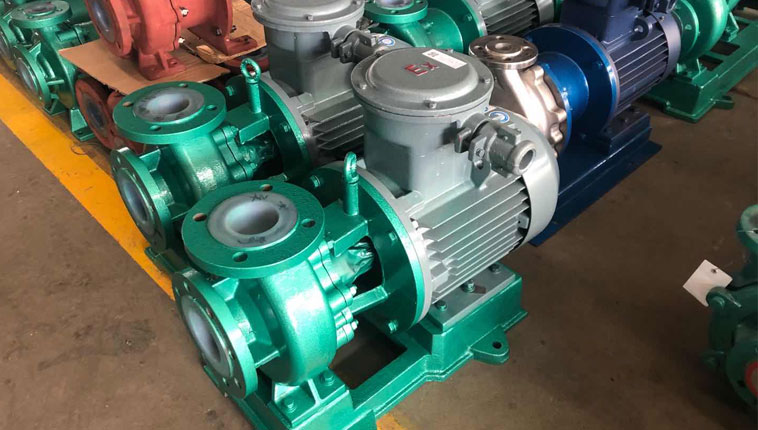
For highly corrosive and oxidizing conditions in papermaking bleaching, chemical transportation and clear alkali liquor delivery, fluoroplastic magnetic drive pumps are the preferred solution. With fully fluoroplastic wetted parts and no exposed metal, they prevent metal ions from catalyzing bleaching agent decomposition and ensure stable bleaching performance. The hermetically sealed, leak-free structure eliminates escape of corrosive gases and alkali mist, improving workshop working conditions.
Material Selection and Applicable Scenarios
PVDF material: Suitable for strong oxidizing media such as sodium hypochlorite, hydrogen peroxide and dilute caustic soda in the bleaching section. It delivers excellent oxidation resistance and acid-alkali corrosion resistance, does not catalyze oxidant decomposition, has high mechanical strength, and resists erosion from fine particles in slurry. It is the mainstream material for papermaking bleaching circulation and chemical transportation.
FEP/PFA fluorine-lined structure: For high-temperature concentrated alkali and high-grade bleaching agent delivery, this structure offers stronger chemical inertness, higher temperature tolerance and superior anti-permeability. It withstands long-term corrosion from medium-high temperature concentrated caustic soda and concentrated bleaching liquor with extremely low ion precipitation, adapting to fine bleaching processes for high-end paper grades.
Optimized flow passage design: The pump chamber and impeller adopt integral fluorine lining with a smooth inner wall, reducing fiber and filler adhesion and scaling. For clear liquid conditions with a small amount of fibers, wide-flow-passage impellers are available to improve fine fiber passability and reduce clogging risk.
III. Supplementary Applicable Pump Types (for Specific Working Conditions)
1. UHMWPE Fluorine-Lined Centrifugal Pump (Main Type for Black Liquor / White Liquor / Slurry)
For high solid-content, high-wear conditions such as alkali recovery black liquor, white liquor and fiber-containing slurry, this pump uses an ultra-high molecular weight polyethylene (UHMWPE) lining with wear resistance 7–10 times that of ordinary stainless steel, plus excellent strong alkali corrosion resistance. Equipped with open or semi-open impellers, it delivers strong fiber clogging resistance and particle erosion resistance, making it a cost-effective choice for pulping and alkali recovery sections.
2. Fluorine-Lined Mortar Pump (Special for High-Concentration Pulp / Sludge)
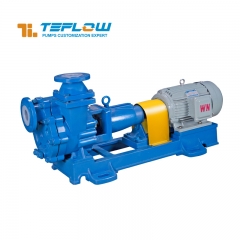
Designed for extremely high solid-content media such as high-concentration pulp, papermaking sludge and lime milk, this pump adopts a wear-resistant fluoroplastic lining and large-channel wide-flow-passage structure. It is specialized for conveying slurry media containing fibers and solid particles, with anti-clogging and erosion-resistant performance, solving the pain points of easy wear and clogging faced by ordinary magnetic drive pumps and centrifugal pumps under high solid-content conditions.
3. Fluorine-Lined Self-Priming Pump (Special for Wastewater / Low-Level Tanks)
For wastewater treatment and underground tank chemical lifting scenarios, fluorine-lined self-priming pumps retain the full fluoroplastic corrosion resistance advantage while adding self-priming capability. They can be started without priming, adapting to the delivery needs of papermaking wastewater tanks and low-level reagent tanks.
IV. Key Points for Papermaking Pump Selection
1. Precise pump matching by section: Prioritize fluoroplastic magnetic drive pumps for bleaching and chemical transportation; select UHMWPE-lined centrifugal pumps or fluorine-lined mortar pumps for black liquor and high solid-content slurry. Do not use a single pump type for the entire process.
2. Prioritize fiber clogging resistance: For fiber-containing slurry conditions, prefer open/semi-open impellers and wide-flow-passage structures; install filters at the pump inlet to intercept large debris and long fiber clusters for pump protection.
3. Careful material selection for strong oxidizing media: Ordinary metal materials are strictly prohibited for sodium hypochlorite and hydrogen peroxide services. Prioritize PVDF, FEP/PFA fluoroplastics to avoid metal-catalyzed reagent decomposition.
4. Verify material temperature rating for high-temperature concentrated alkali: For high-temperature black liquor and white liquor in alkali recovery, confirm the material's upper temperature limit. Degrading normal-temperature materials for high-temperature service will quickly cause creep and corrosion failure.
5. Supporting sealing and O&M solutions: Magnetic drive pumps are strictly prohibited from dry running; liquid level interlock protection is recommended. For fiber-containing and scaling-prone media, flush the pump chamber promptly after shutdown to prevent fiber drying and alkali scale buildup from jamming the impeller.
V. Summary
The paper industry features a wide range of working conditions: pulping slurry emphasizes anti-clogging and wear resistance, the bleaching section focuses on strong oxidation resistance, alkali recovery prioritizes high-temperature concentrated alkali resistance, and wastewater treatment requires corrosion resistance and stability.
Rational selection centered on the four core principles of "corrosion resistance, anti-clogging, wear resistance and zero leakage" can not only ensure long-period stable operation of papermaking facilities, but also reduce reagent consumption and operation & maintenance costs, improving the overall operational efficiency of production lines.



 +86+0563-5093318

