


 +86 18130251359
 teflowpumps@tlpumps.com


Printing and dyeing is the most chemical-intensive segment in the textile industry chain. From pretreatment processes including desizing, scouring, bleaching and mercerizing, to post-finishing procedures such as dyeing, printing and washing, and further to terminal wastewater treatment, the process fluids throughout the entire workflow are complex and variable. Caustic soda, hydrogen peroxide, dye liquor, acid fixing solution, leveling agents and printing & dyeing wastewater appear alternately. These fluids generally contain dye suspensions, fiber debris and salt-based auxiliaries, featuring wide pH fluctuation, strong oxidizing property, high clogging risk and severe abrasion.
As core equipment for dye liquor circulation and chemical delivery, improperly selected pumps are prone to failures such as corrosion perforation caused by oxidants, clogging from fiber entanglement, dye liquor leakage and contamination, and excessive impeller wear. These failures not only result in scrapped dye liquor and color-defective products, but also pose safety and environmental risks due to leaked strong alkali and bleaching agents.
I. Working Conditions Across the Printing and Dyeing Process and Core Pain Points of Pump Application
Although process fluids vary significantly across different printing and dyeing procedures, there are four common challenges universally present:
1. Diverse corrosive media: Covering concentrated caustic soda, hydrogen peroxide, acid fixing solution and various dyeing and chemical auxiliaries, with a wide pH range and often accompanied by high temperatures of 40–90℃. Ordinary metal pumps are susceptible to pitting corrosion and intergranular corrosion.
2. Coexistence of solid phases and fibers: Dye particles, slurry suspensions and short fiber lint exist in all procedures, easily causing flow passage clogging and impeller wear. Traditional narrow-passage pumps have a high failure rate.
3. High leakage risk: Most dyeing chemicals are volatile and irritating. Shaft seal leakage not only causes material loss, but also leads to workshop environmental pollution and potential safety hazards.
4. High operation intensity: Under the continuous production mode, pumps need to operate stably for long periods, and maintenance frequency directly affects production capacity and comprehensive costs.
II. Pump Selection Recommendations by Process
(1) Pretreatment Process: Desizing, Scouring, Bleaching and Mercerizing
- Core media: High-temperature caustic soda solution, hydrogen peroxide, scouring agents, concentrated alkali for mercerizing
- Working characteristics: Strong alkalinity, high oxidizing property, high temperature (scouring can reach above 90℃), relatively clean fluids with a small amount of slurry and fibers
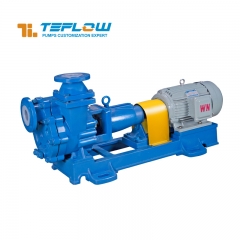
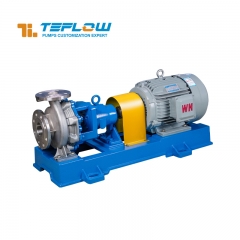
- Recommended pump types: Fluoroplastic magnetic drive pumps, fluoroplastic centrifugal pumps
Pretreatment is the most corrosive segment in the printing and dyeing industry. Concentrated caustic soda and high-temperature hydrogen peroxide are highly corrosive to stainless steel and ordinary engineering plastics, while this process also imposes strict requirements on leakage control.
- Fluoroplastic magnetic drive pumps: All wetted parts are made of fluoroplastic materials such as FEP, PFA or PVDF, which can withstand most acids, alkalis and oxidizing media. Combined with the seal-free magnetic coupling design, they achieve complete zero leakage. They are particularly suitable for delivering concentrated caustic soda in the mercerizing process and hydrogen peroxide in the bleaching process, thoroughly eliminating leakage problems of traditional packing seals and mechanical seals.
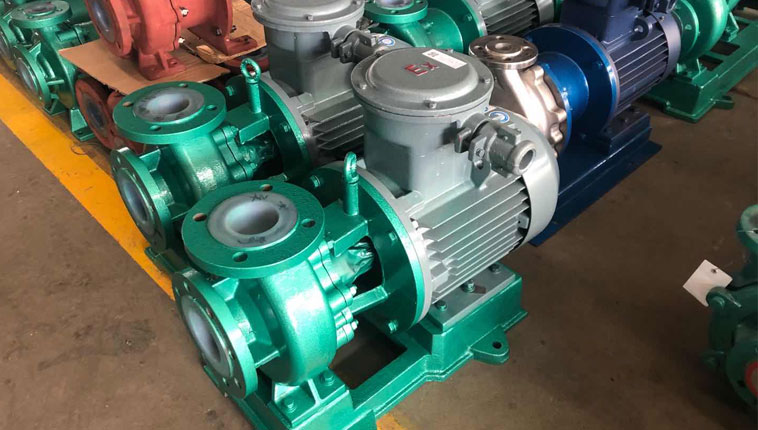
- Fluoroplastic centrifugal pumps: Suitable for high-flow, medium-head scenarios such as scouring liquor circulation and desizing wastewater delivery. Adopting a fluoroplastic lining structure, they balance corrosion resistance and mechanical strength, with lower maintenance costs than magnetic drive pumps. They are applicable to working conditions with average fluid cleanliness and moderate sealing requirements.
(2) Dyeing and Printing Process
- Core media: Dye liquor, acid fixing solution, leveling agents, printing paste
- Working characteristics: Frequent alternation of acid and alkali, containing dye particles and slurry suspensions, multi-batch small-batch production, frequent color and material changes
- Recommended pump types: Fluoroplastic centrifugal pumps, pneumatic diaphragm pumps, small fluoroplastic magnetic drive pumps
The dyeing process involves complex fluid compositions, requiring resistance to alternating acid-alkali corrosion, avoidance of wear and clogging from dye particles, and adaptation to flexible production rhythms.
- Fluoroplastic centrifugal pumps: As the main workhorse for dye liquor circulation and large-batch dye delivery, they adopt a wide-passage impeller design that allows dye particles of certain particle sizes to pass through. Their dye corrosion resistance is far superior to that of stainless steel pumps, and long-term operation will not cause dye discoloration or impurity precipitation due to corrosion.
- Pneumatic diaphragm pumps: Powered by compressed air, they have self-priming capability and can run dry. With no rotating shaft seal structure, they feature high sealing reliability. They are especially suitable for small-batch, multi-variety printing paste delivery and dye drum unloading. They are easy to flush during color changes, effectively avoiding cross-contamination. In addition, pneumatic drive is intrinsically safe, meeting the explosion-proof requirements of dyeing and chemical workshops.
- Small fluoroplastic magnetic drive pumps: Used for precise delivery of high-value dyeing chemicals and auxiliaries, their zero-leakage feature can significantly reduce the loss of valuable materials.
(3) Washing Process
- Core media: Washing wastewater containing residual dyes, auxiliaries and short fibers
- Working characteristics: Moderate corrosiveness, containing a large amount of fiber lint and suspended solids, high flow rate with low head, continuous operation
- Recommended pump types: Corrosion-resistant self-priming pumps, vertical submerged pumps
The washing process features large water volume and abundant fiber impurities, with core demands of clogging prevention, stable operation and easy maintenance.
- Corrosion-resistant self-priming pumps: The main body is made of FEP or PVDF, with excellent acid and alkali resistance. They have self-priming capability without the need for priming. The impeller adopts an open or semi-open wide-passage design, which is not easily entangled or clogged by fibers. They are suitable for wastewater transfer and drainage in each washing tank, with convenient installation and maintenance.
- Vertical submerged pumps: Installed in a submerged manner and placed directly above the washing sump, they eliminate priming and cavitation issues. The long-shaft design adapts to deep-tank working conditions, and the wide-passage structure of wetted parts can effectively pass fiber impurities. They are suitable for in-tank circulation and lifting delivery in continuous washing lines.
(4) Wastewater Treatment Process
- Core media: Comprehensive printing and dyeing wastewater containing dye suspensions, salts, short fibers and sediment particles, with wide pH fluctuation
- Working characteristics: Coexistence of abrasiveness and corrosiveness, high solid content, high clogging risk, requiring stable high pressure for filter press feeding
- Recommended pump types: UHB wear-resistant and corrosion-resistant mortar pumps, corrosion-resistant self-priming pumps
Wastewater treatment is the harshest segment for pump operation in printing and dyeing, and also a high-incidence area for wear and leakage failures of traditional pumps. Differentiated pump selection is required according to specific scenarios.
- UHB wear-resistant mortar pumps: The wetted parts are lined with ultra-high molecular weight polyethylene (UHMWPE), combining excellent acid-alkali resistance and wear resistance. With high hardness and erosion resistance, matched with a large-passage anti-clogging impeller, they can smoothly transport printing and dyeing wastewater containing fibers and sediment. They are suitable for conventional wastewater delivery scenarios such as equalization tank lifting and biochemical tank circulation.
- Corrosion-resistant self-priming pumps: Suitable for mid-stage wastewater delivery with low suspended solid content, such as sedimentation tank effluent and clear water reuse. The FEP/PVDF material can withstand salt, acid and alkali corrosion in wastewater, with low operating energy consumption.
III. Core Selection Principles for Chemical Pumps in the Printing and Dyeing Industry
1. Acid and alkali resistance: Material compatibility is the foundation
Select wetted materials based on medium concentration and temperature gradient: For strongly oxidizing, high-temperature acids and alkalis, FEP/PFA fluoroplastics are preferred; for medium and low concentration acids and alkalis, PVDF is optional; for wastewater conditions with particle abrasion, UHMWPE wear-resistant lining is prioritized. Avoid blindly selecting stainless steel — most printing and dyeing media cause intergranular and pitting corrosion to stainless steel, resulting in a service life far shorter than that of fluoroplastic pumps.
2. Dye corrosion resistance and wear resistance: Balanced dual performance
Dye molecules and auxiliaries often contain polar groups, which easily cause swelling and erosion to ordinary materials, while dye particles and sediment cause abrasive wear. For media containing solid phases, a composite structure of "corrosion-resistant base material + wear-resistant lining" is preferred to avoid the trade-offs of single materials.
3. Clogging prevention: Flow passage design takes priority over material
Fibers and suspended solids are the main causes of pump clogging in printing and dyeing. When selecting pumps, prioritize models with wide flow passages, open/semi-open impellers and large-diameter inlets and outlets, and avoid conventional centrifugal pumps with narrow passages and multiple blades.
4. Zero leakage: Sealing structure determines environmental protection and safety
For highly corrosive, high-value and volatile media, seal-free pump types such as magnetic drive pumps and diaphragm pumps are preferred to eliminate leakage points structurally. For scenarios where centrifugal pumps must be used, cartridge mechanical seals with flushing plans are prioritized. Zero-leakage design not only meets environmental compliance requirements, but also significantly reduces dyeing chemical loss, delivering outstanding long-term economic benefits.



 +86+0563-5093318

